Tuesday, April 16, 2013

TAO’s two takes on Reservoir Dogs


The men. Photo courtesy Andy Kuna
Theater Artists Olympia has taken on some tough challenges. This one has paid off in great performances, excited audiences, and lots of blood and gore. It is also — at least in the early scenes — a laugh riot. 

The play is based on the Quentin Tarantino movie and directed by Pug Bujeaud, and they are doing two versions: one with an all-male cast and one with an all-female cast. I should not have to warn those who are familiar with Tarantino’s work that it is filled with profane language, including sexist and homophobic remarks and the most offensive of racial slurs. And there is more graphic violence in this play than in any play I’ve seen, with the possible exception of TAO’s Titus Andronicus, which was also directed by Bujeaud. 


The women. Photo courtesy Andy Kuna
There is sometimes a fine line between art and pornography, and Reservoir Dogs is art. It is outstanding art.

On a very limited budget and in a tiny performance space, this cast and crew have created riveting theater. The set designed by Marko Bujeaud and Michael Christopher (who plays Blonde in the male cast) consists of a table top, some chairs and some moveable boxes with everything painted a dull battleship gray. This stark set enhances the gritty action, as does the videography by Two Bards Productions and the great ’70s music. The shatteringly climactic scene is choreographed to “Stuck in the Middle With You,” choreography by Christian Doyle.

There is no way I can single out every actor whose performance deserves recognition, because they all do. I will mention a few whose acting is extraordinary.

In the female cast Jennifer Rifenbery is cold as ice as Blonde. Her acting is the epitome of self-contained energy. Whereas Rifenbery’s Blonde comes across as calculating and evil, Heather Christopher’s Pink is a wisecracking, smartass, streetwise broad who doesn’t put up with anything, doesn’t trust anyone, and flies off the handle at the slightest provocation. Christopher’s acting is a joy to watch.

Heather Cantrell as Nice Guy Eddie and Dana Galagan as Jo are both explosive, and Kate Ayers plays White as a pent-up bundle of nerves. 

This whole female cast is deserving of an award for ensemble work. So is the male cast.
The differences between the all-female and all-male casts are subtle but fascinating to observe. 

Like Rifenbery in the female cast, Michael Christopher plays Blonde as a cool customer, but his performance is more humorous. Both are chilling in meting out calm and measured mayhem, but Christopher does it with maniacal glee. Similarly, Christian Doyle and Cheyanne Logan are each convincing as the gut-shot Orange and turn in powerful performances in the climactic scenes, but in the earlier scenes Doyle plays it with sly humor and Logan is more naturalistic. 

Brian Jansen’s Pink makes Heather Christopher’s Pink look even more manic by comparison; Jansen’s Pink is more subtle but equally funny. Mentioning these differences in approach is not in any way to imply that one is better than the other. They are all excellent, and each brings something unique to the stage.

Other outstanding performances by the men were those of, Tim Shute as Joe, and Tim Samland as Holdaway.

Doing both a male and a female version was Bujeaud’s idea, and it was brilliant. Unless you are easily offended by excessive cursing and violence you really should get yourself down to The Midnight Sun and see this play. If possible, take in both. There are discounts for the double feature, the "Gender-Blender Special."


Check out the video “Get a Sneak Peek at the cast” by stage manager, Vanessa Postil.

Reservoir Dogs Men:
April 19,21,25,27 - 7:30 pm
April 20,26 - 10:00 pm


Reservoir Dogs Women:
April 18,20,26 - 7:30 pm
April 19,27- 10:00 pm
April 21,28 - 2:30 pm


The Midnight Sun Performance Space, 113 N. Columbia Street in downtown Olympia.
Tickets: $12.00 available at the door or online at http://www.brownpapertickets.com/event/280157

Friday, April 12, 2013

Legally Blonde at TMP


The News Tribune, April 12, 20-13

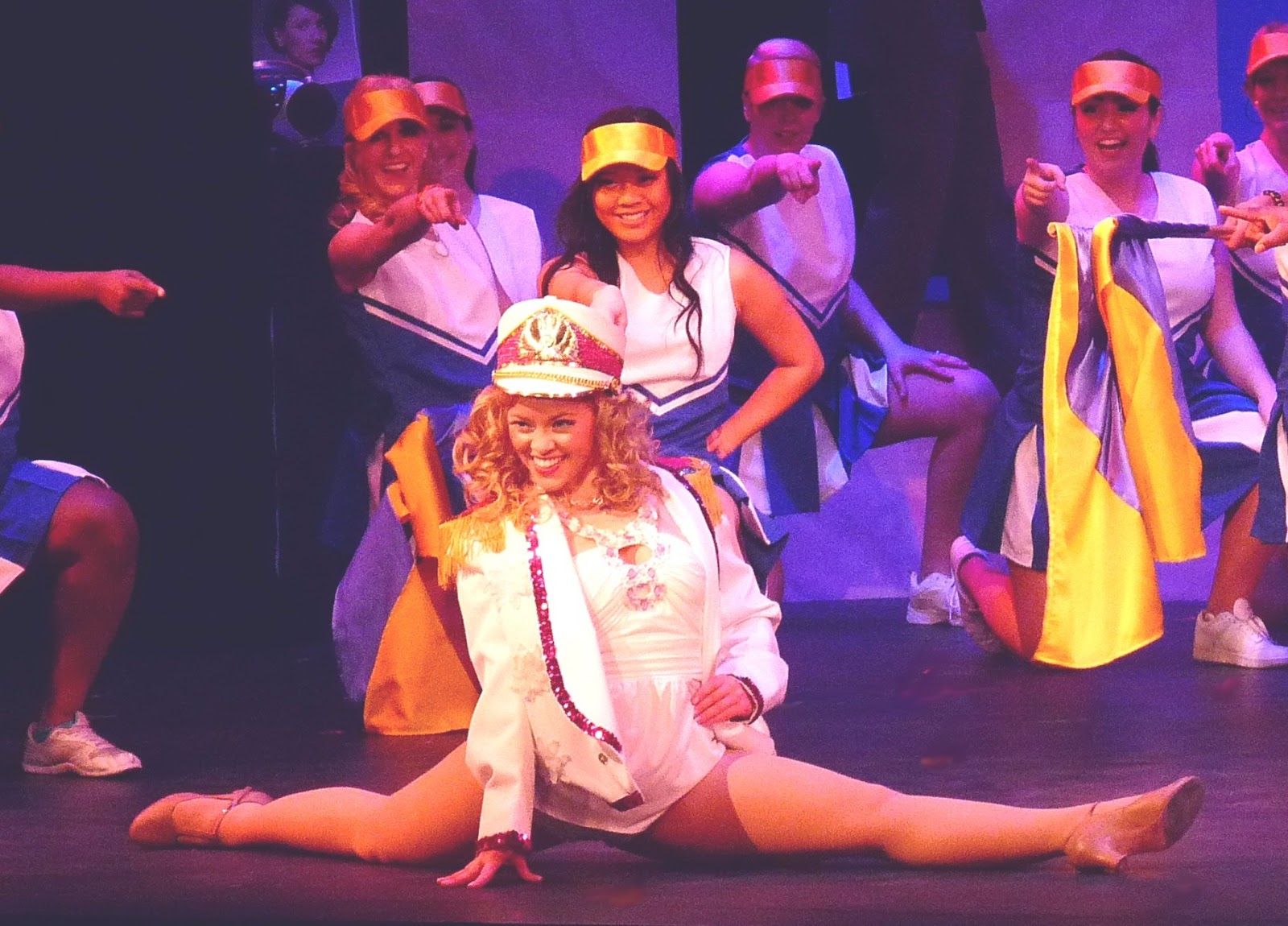
Leah Wickstrom is Elle Woods in "Legally Blonde" at Tacoma Musical Playhouse. Photo by Kat Dollarhide.
“Legally Blonde” the musical at Tacoma Musical Playhouse is a high-energy song and dance fest replete with silly jokes from sorority girls and scheming law students. Based on the popular film starring Reese Witherspoon, it’s the story of Elle Woods (Leah Wickstrom), the epitome of a ditzy blonde who goes to Harvard Law in order to recapture the love of the boyfriend, Warner Huntington III (Steve Barnett), who dumped her. Elle turns out to be a much shrewder lawyer than anyone expects. In the early scenes it seems that everyone is either superficial or nasty, but soon we see that it’s all being played tongue-in-cheek and the audience is let in on the joke. In real life, for instance, Elle would never have gotten into Harvard, or if she had gotten in it would have been because her daddy paid somebody off, not because of her cleverness. 

Wickstrom has the face and the figure and, of course, the blonde locks. In fact, she looks a lot like Reese Witherspoon. So perfectly does she fit the part physically that it would be easy to assume she was cast for her looks. But she also has the voice and rhythm, the moxie and the acting skills to captivate the audience. 

Barnett too could have been cast for his looks, but proves to be a skilled actor. He is tall and handsome, and he does a stellar job of bringing his character to life. He plays Warner as almost despicable, haughty and self-absorbed; yet underneath that slick exterior is likeable young man.

Leah Wickstrom and Bruce Haasl; F. James Raasch and Brittany Henderson in background. Photo by Kat Dollarhide.
The other lead character is Emmett Forrest (Bruce Haasl), the good guy you can’t help but cheer for. Haasl is a newcomer to TMP, but for years he’s been a mainstay at Olympia’s Capital Playhouse, where he has wowed audiences with knockout performances in “The Buddy Holly Story,” “Rent,” “Jesus Christ Superstar” and many more. He has an amazing voice, and my only regret is that he doesn’t get to solo enough in this role.

Also loveable is Lisa Wright Thiroux as Paulette Buonofuonte the hairdresser. She plays this streetwise city gal with gusto. Her lead on the song “Ireland” is one of the highlights of the first act.

Deserving of special recognition are Carlos Barajas and Arthur Cuadros for their raucous dance number on the entertaining song “Gay or European?” These guys brought the audience to their feet.

Jeff Stvrtecky’s band is outstanding, but they were too loud opening night and overpowered the singing in some places. There were also a lot of audio problems including crackling speakers and problems with sound balance that hopefully have been worked out for subsequent shows.

Jon Douglas Rake’s choreography is terrific and there is some great dancing from the ensemble and notably from Wickstrom, whose moves are strong, rhythmical and snappy.

Will Abrahamse’s set is beautiful and functional. It easily changes from a sorority house to the Harvard Law School, and the costumes are colorful and inventive. Elle’s outfits range from the sublime to the ridiculous, her drum majorette outfit is magnificent, and she wears enough hot pink for an entire Delta Nu sisterhood.
Sellout audiences are expected throughout the run, so get your tickets early.

WHEN: 8 p.m. Friday and Saturday and 2 p.m. Saturday and Sunday through April 28
WHERE: Tacoma Musical Playhouse at The Narrows Theatre, 7116 Sixth Ave., Tacoma
TICKETS: $20-$29
INFORMATION: 253-565-6867,
http://www.tmp.org

Wednesday, April 10, 2013

Stephanie Stebich’s lecture on Eric Carle’s”ArtArt”


by Alec Clayton
for the Weekly Volcano's blog Spew
April 8, 2013

Small Raised Circles, © 2011 by Eric Carle. Photograph, 8 x 10 inches. Collection of Eric and Barbara Carle, courtesy of The Eric Carle Museum of Picture Book Art, Amherst, Massachusetts. This exhibition was organized by The Eric Carle Museum of Picture Book Art, Amherst, MA.

Large Circles, © 2007 by Eric Carle. Photograph, 8 x 10 inches. Collection of Eric and Barbara Carle, courtesy of The Eric Carle Museum of Picture Book Art, Amherst, Massachusetts. This exhibition was organized by The Eric Carle Museum of Picture Book Art, Amherst, MA.
Note: this was published the day before the lecture but is still pertinent as long as the show is up.

Tacoma Art Museum Director Stephanie Stebich will lecture on the personal and private art of children’s book artist Eric Carle Wednesday, April 10 at 10:30 a.m. The lecture is free with museum admission, and it should be as special as is the exhibition because she is a personal friend of the artist and knows him well.

I was fortunate enough to attend a press preview of the exhibition at which Stebich toured the show with us and talked about Carle’s art. My review will appear in this week’s Volcano. But there’s much more to the show than I can say in one review, so I’ll try to cover a little more here.

Carle is famous for his colorful book art. His most famous book here in the United States is The Very Hungry Caterpillar, but Stebich says Brown Bear — Brown Bear, What Do You See? is more popular in Europe. What very few people know is that throughout his entire life he has made art that was never intended for public display, which he calls his “ArtArt.” It is this private and personal work that makes up the bulk of the exhibit. It is mostly abstract paintings and collages using acrylic paint and colorful tissue paper.

Among the more interesting things to be seen is his “Name” art. When he writes to close friends he often likes to embellish his notes with original art, and often the way he does that is to write their names in colorful collage art. There are quite a few of these in the show and they strike a balance visually between his purely abstract work and his delightful children’s book illustrations.

In 2001 he designed costumes and set designs for The Springfield Symphony’s performance of Mozart’s “The Magic Flute.” You can see some of the actual costumes in this show along with sketches for his designs. In the process of working on these he discovered a material called Tyvek, and he began making mural size paintings on Tyvek using a broom and large paint brushes. Two of these murals are on display at TAM, one of which he created especially for this show.

Early in his career Carle experimented with combining linocuts and photography. “Combining these two elements was an interesting graphic exercise for me,” he says.
This earlier experimentation with photography led to more recent photographic work in which he zooms in on textures and details on streets.

There are also some colorful little photographs that remind me a lot of Larry Poons’ optical paintings of circles and ellipses from the 1960s. (Does anybody remember Poons? He’s a fascinating painter whose work deserves more attention than it gets. But that’s another story.)

For a radical departure from his brightly colored abstract works there are a lot of linoleum block prints of animals and tea pots and a Conestoga wagon. These prints are dark and simple and have an early Americana look. They were all done in 1965 and are perhaps the most distinctive pieces among a number that illustrate Carle’s wide range of style, media and ideas.

The works I have mentioned here are but a few of the works to be seen in this wonderful show that spans two of the museum’s large galleries. 

My review of the Eric Carle exhibition will be published in the Weekly Volcano on Thursday, April 11.


Sunday, April 7, 2013

Discover Peggy Lee

"... any way you discover Peggy Lee is a good way."

So says Michael Dresdner, and I agree.

"For those of us who’d like to rediscover, or at least revisit, this amazing icon of songwriting and performing, there’s good news. David Duvall and his Purple Phoenix Productions will be offering a ONE NIGHT ONLY tribute concert of Peggy Lee songs at Centerstage."

Read more on Dresdner's Theatre Reviews..

Friday, April 5, 2013

The Somewhat True Tale of Robin Hood at Olympia Family Theater


reviewed by Alec Clayton

Ryan Holmberg as Prince John
Dennis Worrell as Robin Hood

I had such a good laugh last night at Olympia Family Theater’s The Somewhat True Tale of Robin Hood. This is children’s theater that adults can love while children are charmed, and judging by almost sellout the audience the night I attended no one is too old or too young to enjoy it because it has everything from great slapstick comedy to rollicking adventure to brilliant word play to audience participation. 

It is a loud play with lots of frantic running around and lots of shouting from everyone except Town’s Guy (Chris Cantrell) who does not speak at all.

The humor is of the Monty Python/Saturday Night Live variety but without the sex, violence and bad language. There are no curse words, but there are plenty of curses, all from the dainty lips of the lovely Maid Marian (Ingrid Pharris Goebel) — curses such as may you have acne, may you have dandruff, may you have itches in places you can’t scratch. (Maid Marian seems obsessed with irritable skin conditions.)

This delightful take on the classic tale was written by Mary Lynn Dobson and is directed by Tom Sanders in his first directorial outing. 

A word about Town’s Guy’s silence: It’s possible, not very likely, but possible, that Cantrell came down with laryngitis and having him not speak was a last minute adaptation and maybe he’ll speak in subsequent performances. But as I said, that’s not very likely. There is a pre-show speech by Robin Hood (Dennis Worrell) in which he explains to the kids what the story is about, invites them to help by shouting out such helpful phrases as “Boo Hiss” every time the evil Prince John is mentioned, and explains the difference between a play and television. And then he explains that the Town’s Guy can’t speak but will narrate the story with gestures only — and then Cantrell in  deliciously underplayed absurdity makes gestures and telling facial expressions throughout the play as Sanders, off stage, speaks his lines. Whatever the reason, whether it was laryngitis or written into the script, it worked beautifully.

Almost every actor in the play deserves special recognition, but I can’t single out every one. They’re all good, starting with Worrell, who plays the Prince of Thieves as a self-satisfied egotistical maniac with big dramatic gestures and poses throughout. He even makes fun of himself, as most of the characters do, by saying things such as don’t interrupt, I’m posing.

Ryan Holmberg knocks it out of the park with his portrayal of the evil Prince John (Boo Hiss!) as a fey poseur, the perfect foil to Robin Hood. 

Goebel’s portrayal of Maid Marian is the most outrageously funny performance I’ve seen from her since her mid-boggling performance in Don Juan in Chicago five years ago.

Outstanding in supporting roles are Christine Goode as the Lady in Waiting, Christian Carvajal as Little John (who knew this celebrated dramatic actor could do abject idiocy so well?), and Bobby Brown as Friar Tuck.

Take the kids or take a date. Either way you’ll love it.

Robin Hood runs through April 14 at The Washington Center for the Performing Arts Back Box Theater, 512 Washington St., Olympia.

Performances Thursday and Friday at 7 p.m. and Saturdays and Sundays at    1 p.m., with an additional 4:30 matinee Saturday, April 13.   

Tickets:    
Children 12 and under $9, Students/Seniors/Military $12, Adults $16 (Plus    $3 WA Center Service Fee per ticket). Available online at www.olytix.org, by phone at (360) 753-8586 or at the WA Center Box Office. Discounts available for groups of 10 or more. Discounts only available by phone or in person at the box office.


You Are Here


Michael Johnson’s new sculptural installation at Kittredge Gallery
The Weekly Volcano, April 4,2013


The fascinating thing about Michael Johnson’s new sculptural installation at Kittredge Gallery is that you can see it from many perspectives, literally and metaphorically. The installation is in the smaller back gallery. Viewed through the double open doors from the larger front gallery it can be taken in in a single, all-encompassing glance, and from this initial glance a viewer can gain various impressions and interpretations. Then walk into the gallery and take a closer look and you will see it in one or more entirely different lights. Finally — and you should do this only after thoroughly looking — read the explanation on the wall label to understand what you’re looking at.

My initial impression when scanning the room was that I was seeing a Japanese home or a theatrical set design. The overall impression was of power, stark contrasts and elegance of form. Of course the big red dot on the back wall helped to foster that impression. It looks like a Japanese flag, and the sparse forms suspended from the ceiling in front of it and throughout the room look like Japanese screens. Or like some Matrix-like futuristic scene.

Underneath the big red dot are the printed words “You Are Here,” and under that is printed: “47 15.8’N/122 28.7’ W”  — presumably points of latitude and longitude — and we realize that the crux of the installation has to do with directions. The red dot is the starting point seen on directional schematics in a building such as a mall or the lobby of an institutional complex.

Walking into the gallery we get a better look at the forms suspended from the ceiling. There are six of them, each approximately eight-feet square suspended horizontal to the floor from wires and about the level of the viewer’s knees. There is no indication of media, but my guess would be wood painted black. They look much heavier than they probably are, and there is a feeling of defying gravity or a conflict of massiveness and lightness. I’m reminded of the title of Milan Kundera’s book The Unbearable Lightness of Being.

When close enough to look down on these forms we see a network of curvilinear shapes that worm their way through the open space between the four sides of a heavy black frame. These shapes also have the flavor of Asian writing, which resonates back to my first impression of a Japanese house, or perhaps a shrine.

The forms are slightly minimalist, expertly crafted and elegant from a purely aesthetic point of view, regardless of whatever meaning or interpretation may be taken from them. The formal fascination is in comparing the intricacy of the parts to the simplicity of the whole.

But there is meaning beyond the formal elements. The wall text explains that the shapes of the pieces, which are referred to as a three-dimensional drawing, represent paths traced by GPS technology and computer-generated visual code.

I don’t usually treat a work of visual art like a mystery performance, but I’m going to withhold the answer to the question who or what created the pathways and how he, she or it did it. It will be more fun for viewers to discover that for themselves.

I’ve seen only one other show of Johnson’s sculpture, and I have been impressed with everything I’ve seen so far. His work is inventive, intelligent and created with sensitivity to form and finely honed craftsmanship.

[Kittredge Gallery,  You Are Here,  by Michael Johnson, through April 13, Monday-Friday 10 a.m. to 5 p.m., Saturday noon to 5 p.m., 1500 N. Warner St., Tacoma, 253.879.3701]