Friday, March 25, 2022

Sara Gettys ‘Warmer Days’ at Childhood’s End

Reviewed by Alec Clayton
In the early-to-mid 20th century, commercial art and comic art were considered something less than fine art. And then along came Andy Warhol with his soup cans and multiple celebrity portraits and Roy Lichtenstein with his blown-up comic strip images and the surrealistic comic art of the Chicago School, a.k.a. the Hairy Who. The border between so-called fine art and comics and advertisements vanished, and many people didn’t know what to take seriously and what to ridicule. As the song says, “Anything Goes.”

There are elements of all these approaches to art in Sara Gettys’ exhibition “Warmer Days” at Childhood’s End Gallery. In the front window hangs the massive “Exuberance,” a painting in acrylic on wood of two black bunnies boxing. The exuberant flair of this painting will hopefully draw many pedestrians and motorists into the gallery where they will find almost a hundred works of art by Getty, including paintings and porcelain/mixed media sculptures — all colorful, playful, and exciting. Yet, as playful and cartoonish as they are, this is serious art.

Her images are mostly of rabbits with a few horses and birds and flowers thrown in. Her sculptures include bowls, plates, and flowerpots with fantasy flowers that stand alone or hang on walls. Edges of shapes in her paintings are generally hard, but the paint application within shapes varies from smoothly to roughly brushed with interior patterns of dots or stripes, and large swaths of color. In other words, the rabbits and birds and flowers appear on first look to be flat cut-out shapes adhered to canvas or wood with all the painting being patterns and shapes within them.

“Hare” is a large red and pink head of a rabbit with overlapping areas of color and a dot pattern outside the image on a ground that appears to be behind the rabbit in places and to overlap the rabbit in other places.

“Rabbit 1-16” is a stacked series of 16 paintings with paper, ink, and thread with large areas of loosely brushed red, blue, turquoise, and orange with line drawings of rabbit heads that weave in and out.

“After Everything We’ve Been Through” pictures the silhouette of a bird soaring from bottom right to upper left with inside the silhouette expressively painted areas of yellow, orange and blue.

“Big Agave” dominates the back wall of the gallery going almost floor to ceiling. It pictures a stylize red agave plant above a line drawing in white and blue of three rabbits.

“Dream Rabbit in Moonlight” is a black porcelain rabbit imprisoned by what appears to be bands of gold duct tape. It is a morbid image among so many playful images.

Overall, this is an impressive show and a bright welcome to the warmth of spring after a long and depressive winter and fall. In a statement on the gallery website, Gettys said "Warmer Days is a project I started as a way to push back on the chill dreary days of our PNW winter and the anxiety and uncertainty of the past two years of the COVID-19 pandemic."

On Dec 6th, 2021, the Cultural Key to the City was awarded by Mayor Selby to Childhood’s End owners, Bill and Richenda Richardson, followed by the Business of the Year award from the Olympia Downtown Alliance

Sara Gettys ‘Warmer Days’
10 a.m. to 6 p.m. Monday-Saturday, 11 a.m. to 5 p.m. Sunday
Childhood’s End Gallery
222 4th Ave W Olympia

Monday, March 21, 2022

God Said This at Dukesbay Productions


Reviewed by Alec Clayton


Jim Winkler and Aya Hashiguchi

James (Jim Winkler) is a gruff, profane and loveable Kentucky hillbilly, a recovering alcoholic obsessed with collecting and selling rocks. He serves as character in and narrator of Leah Nanako Winkler’s God Said This. The “audience” to his narration are fellow alcoholics (not seen on stage) at his AA meeting. He opens the play by introducing himself and saying he’s an alcoholic, that his wife, Masako (Aya Hashiguchi), is in the hospital with cancer, that his oldest daughter, Hiro (Leilani Berinobis), hates him, and his youngest daughter, Sophie (Jasmine Jaqua), has found religion. James and Hiro think Sophie’ religiosity is absurd, but Masako prays with her, and that just might have healing power.

During his drinking days, James was an abusive father. Now he wants to make up with his daughters, but they’re having nothing to do with it.

Hiro is a worldly rebel determined to crush the expectations of a dutiful Japanese-American girl. All of the women, in fact, shatter the cliched images of Japanese women, and James is nothing like the stereotypical redneck alcoholic. They are all well-rounded complex human beings.

Enter John (Jacob Tice), Hiro’s old high school friend. He is a single father who never left his Kentucky home, and Hiro assumes he’s a downhome, uncomplicated playboy. They get drunk and high together, and Hiro wants to “make out” (her term) with him. But he wants nothing to do with that. He wants their friendship to be one-hundred percent platonic (his terminology)—proving that he, like all the family, fits no stereotypes. He has a post-graduate degree and is dedicated to loving and protecting his thirteen-year-old son.

The cast is outstanding, including Berinobis as Hiro is a stand-in for the originally cast actor and had only four rehearsals before opening night. She performed with script in hand but did not need it all the time and did not let that hamper her performance.

Both Winkler and Tice fit so smoothly into their roles that it seems they are not acting at all.

Hashiguchi plays the wife/mother, Masako, as brave and loving with the sweetest of smiles, but

Hiro (Leilani Berinobis) and John (Jason Tice)

she sometimes breaks down into unstoppable sobbing.

Jaqua’s Sophie is the only character who comes close to behaving like the sweet and dutiful Japanese daughter. She is quiet and seemingly shy but stands up bravely in the practice of her brand of Christianity and surprises everyone from time to time with her rebelliousness (smoking a joint, for instance).

The family was not able to get along in the past, but in coming together to be with Masako they learn to forgive and to love one another.

Kudos to director Randy Clark, sound designer Niclas Olson and lighting designer Michelle Weingarden Bandes for their excellent work.

God Said This was the 2018 winner of the Yale Drama series competition chosen by Pulitzer Prize-winning playwright Ayad Aktar, who described it as conveying “a deeply felt sense of the universal—of the perfection of our parents’ flawed love for each other and for us . . .”


God Said This

7:30 p.m. Friday, Saturday, 2 p.m. Sunday through April 3

Dukesbay Theater, 508 6gh Ave. upstairs above the Grand Cinema (no handicap access)

$15 at DukesbahyGodSaidThis.eventrite.com

www.dukesbay.org

Sunday, March 6, 2022

A Chorus Line at Tacoma Little Theatre


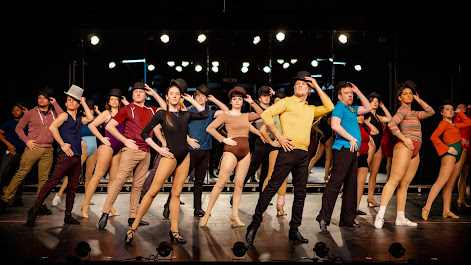
The ever popular A Chorus Line was scheduled to open at Tacoma Little Theatre two years ago but got shut down by Covid. Finally it’s back, with direction and choreography by Eric Clausell and musical direction by Jeff Bell.

From the pen of legendary composer Marvin Hamlisch, come seventeen Broadway hopefuls who divulge their very touching life stories as they sing and dance their hearts out in a cattle-call style audition for a new Broadway musical.

A Chorus Line brilliantly evokes both the glamour and grind of showbiz, and is the musical for everyone who’s ever had a dream and put it all on the line. The iconic score of this Tony and Pulitzer Prize-winner features such classics as “What I Did for Love,” “One,” “I Hope I Get It”, “Singular Sensation” — and let’s not forget the hilarious “Tits and Ass.”

Tacoma Little Theatre’s production of A Chorus Line features: Heather Adams Arneson as Lara, Ian Bartlett as Mark, Haunz Stroschein as Gregory, Mallory Carbon as Judy, Richard Cubi as Mike, Loucas Curry as Richie, Roycen Daley as Paul, Emma Deloye as Maggie, Nick Fitzgerald as Bobby, Valentine Fry as Kristine, Melanie Gladstone as Val, Anna Herron as Vicky, Keola Holt as Diana, Devin Jackson as Ensemble, Danielle Locken as Sheila, Annelise Martin as Ensemble, Allen Melo as Ensemble, Derek Mesford as Don, Rebecca Nason as Ensemble, Micheal O’Hara as Zach, Alan Plaster as Ensemble, Whitney Shafer as Cassie, Natalie Silva as Bebe, Josh Wingerter as Al, Hannah Ashcraft as Ensemble, and Thea Frances Yumang as Connie.

WHEN

7:30 p.m.   Friday and Saturday and 2 p.m. Sunday through April 3.  

WHERE

Tacoma Little Theatre, 210 N. I Street, Tacoma

COST

$29.00, $27.00 (Seniors 60+/Students/Military), and $22.00 (Children 12 and under), pay what you can March 24

A Chorus Line is recommended for ages 12 and up. 

TLT requires proof of COVID-19 vaccination at the door for all audience members and masks will also be required while inside the building.  For our full COVID-19 protocols please visit www.tacomalittletheatre.com/covid.

Photo courtesy of Dennis K Photography


Sunday, December 5, 2021

Olympia Little Theatre fractures the season with The Wickhams: Christmas at Pemberley

Reviewed by Alec Clayton
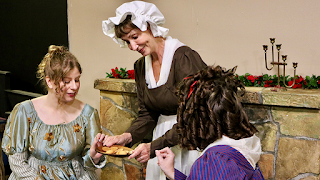
Anne Tracy as Lizzy, Jennie Jenks as Mrs. Reynolds and Erin Cariker as Lydia; photos courtesy Olympia Little Theatre

The Wickhams: Christmas at Pemberley by Lauren Gunderson and Margot Melcon is a companion piece to their Miss Bennet: Christmas at Pemberley (OLT 2019). Both plays take off from Jane Austen’s Pride and Prejudice. If you liked P&P and “Downtown Abbey,” you’ll like The Wickhams

To quote local actor, director, novelist, former critic, all-around good fellow and my colleague at Oly Arts, Christian Carvajal — “ ‘For what do we live,’ asks Mr. Bennet in Jane Austen’s 1813 classic Pride and Prejudice, but to make sport of our neighbours, and laugh at them in our turn?’ Austen may be two centuries in her grave, but her gift for sly satire earned her A-list celebrity- -writer status to this day.

 Ably directed by Kathryn Dorgan, who recently retired as theater teacher at Olympia High School, with beautiful period furniture and gilded wallpaper (properties by Barb Matthews) and costumes by Diana Purvine and Bitsy Bidwell, this production gently sweeps the audience into the Darcy’s palatial estate, Pemberley in England, Christmas time 1815. 
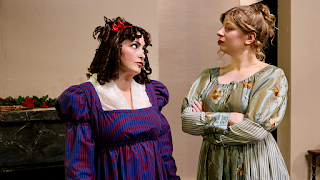
 Erin Cariker and Anne Tracy

The action takes place downstairs in the servants’ work area while upstairs Darcy (Alex Tracy), his wife, Lizzy (played by Tracy’s real-life wife Anne), and Lizzy’s sister, Lydia (Erin Cariker) await guests for a Christmas party. Lydia, who in the first act appears to be a stereotypical airhead with an irritatingly squeaky voice, is at-the-moment, the sort-of-estranged wife of George Wickham (Andrew Stashefsky), a nasty and self-centered if not downright evil man who is Darcy’s sworn enemy. Cariker is reprising her role as Lydia from OLT's afore-mentioned Miss Bennet: Christmas at Pemberley.)

Downstairs, head housekeeper Mrs. Reynolds (Jennie Jenks), young servant girl Cassie (Kaylee Hawkins) and footman Brian (Leo King) are preparing for the party when the loud, obnoxious and drunken Wickham bursts in. What ensues is well-mannered farce and mayhem, with a bit of romance. Exception: there is nothing well-mannered about Wickham. 

Most of the cast, except for Jenks, are new or relatively new to Olympia stages. Jenks has performed in many OLT shows including Jekyll and Hyde, Dixie Swim Club and others, and has performed in area theaters for almost 30 years. As Mrs. Reynolds she is the glue that holds this play together. Her emotions, matching her character, are kept in check as subtly expressive. 

 Hawkins was recently in Go Back for Murder at OLT and How I Learned to Drive at the Twilight Theater Company in Portland. She plays Cassie as sweet and innocent. Alex and Anne Tracy are recent transplants from Chicago and will be valued additions to the Olympia theater scene. Stashefsky is outstanding as Wickham — the only character in the play who is not restrained by 19th century manners. His acting is enjoyably over the top. And finally, this is Leo King’s first ever onstage performance, and he does a splendid job portraying the likeable Brian. 

Having said all that, The Wickhams: Christmas at Pemberley is a mildly funny period comedy that is well acted and directed. It is enjoyable, but I don’t suspect many people are going to rush to their phones to tell all their friends about it. 

Masks and proof of vaccination are required. 

The Wickhams: Christmas at Pemberley 

7:25 p.m. Fridays, Dec. 10 and 17; Saturdays, Dec. 4, 11 and 18 and Thursday, Dec. 16; 1:55 p.m. Sundays, through Dec. 19. Note: I just heard the Sunday shows Dec. 5 and 12 are sold out. 

Olympia Little Theatre, 1925 Miller Ave. NE, Olympia 

$9 – $15 360-786-9484 

Tuesday, September 14, 2021

Terms of Endearment at Tacoma Little Theatre

review by Alec Clayton

Derek Mesford as Flap and Ana Bury-Quinn as
Emma, photo by Dennis K Photography

Run, drive, crawl to Tacoma Little Theatre to see Terms of Endearment—unless you’re not vaccinated; if you’re not vaccinated and masked, you can’t get in, and kudos to TLT for that.

I’m guessing that many of you are familiar with the story. The stage play is adapted by Dan Gordon from the novel by the great Larry McMurtry and the screenplay for the 1983 movie by James L. Brooks.

It is inevitable that the principal characters: Stephanie Leeper as Aurora, Ana Bury-Quinn as Emma, Scott C. Brown as Garett, and Derek Mesford as Flap Horton, will be compared with the screen actors in those roles: Shirley McClain, Debra Winger, Jack Nicholson and Jeff Daniels. I kid you not, these actors are every bit as stunning in their roles as were their movie counterparts.

Stephanie Leeper as Aurora and Scott C. Brown
as Garrett, photo by Dennis K Photography

Women who have had a difficult love-hate relationship with her mother will relate to the bantering between Aurora and Emma, and anyone who has ever enjoyed a loveable rake such as the old astronaut Garrett, who is the over the hill astronaut, and a drunken seducer of young women will be wonderfully surprised at the rocky relationship between Aurora and Garrett.

Bury-Quinn plays Emma so naturally it seems she appears to be not acting at all but simply is Emma. In the opening scenes, Leeper seems not so natural as Aurora, but soon what seems to be strained acting is actually the visible proof of Aurora’s eccentricity. And then there’s infuriating and loveable Brown. Outside of Jack Nicholson there are few actors anywhere whose stage or screen presence is so dynamic and unforgettable. It is notable that Brown was equally outstanding as Randle McMurphy, another character played by Nicholson, in the 2008 performance of One Flew Over the Cuckoo’s Nest at Lakewood Playhouse.

Director Blake R. York said in a program note that the script called for moving a lot of furniture around on stage and that he and Kathy Pingle, who was originally slated to direct, agreed that moving furniture would detract from the real crux of the play—relationships between people. The static set by York and his wife, Jen, works perfectly. The projected images on picture frames and windows adds just the right touch without being obtrusive.

Terms of Endearment flows easily from comedy to tearjerker. Bring handkerchiefs.

WHAT

Terms of Endearment

WHEN

7:30 p.m. Friday-Saturday, 2 p.m., Sunday through Sept. 26

WHERE

Tacoma Little Theatre, 210 N. I Street, Tacoma

COST

$27 Adults - $25 Students/Seniors/Military - $20 Children 12 & Under

LEARN MORE

https://www.tacomalittletheatre.com/


Wednesday, May 19, 2021

These are my books


Books by Alec Clayton 


People have asked "What are your books about?" These are my books, so far, in capsule and in order of publication. As of this writing there are three more novels in the works. For more information on the books visit Mud Flat Press.


FICTION


Until the DawnA legendary artist vanishes at the height of his career – Red Warner, an artist from a small town in Mississippi, makes it big in New York and then vanishes following a wild party in his SoHo loft. To discover what happened and why, a childhood friend immerses himself in their shared history in a search that carries him back to his Mississippi home and a secluded fishing camp on the coastal bayous. Along the way we learn how a small town football player coming of age in the time between World War II and the sixties became a leading artist of his time and about the secret that has haunted him since he left the South.


Imprudent Zeal - From Mississippi to New York to Seattle, from the 1940s to the close of the twentieth century, five characters who come of age at different times and in different parts of the country are thrown together through happenstance in this saga of modern life.


The Wives of Marty Winters - Gay rights activist Selena Winters is shot in the head while giving a speech at a Seattle Pride celebration. She is rushed to the hospital where a blood clot is removed from her brain. She slips into a coma. Selena’s husband, Marty, and family members gather to wait and see if she will ever regain consciousness.

Family conversations lead back to old conflicts and memories of Marty’s first wife, Maria in the 1960’s.

Freedom Trilogy Book 1: The Backside of Nowhere - a drama of family conflict set in a fictional town near the Mississippi Gulf Coast. Popular movie star David Lawrence has not spoken to his father in more than twenty years. When the old man has a heart attack while driving drunk and careens off the top of a parking garage, David leaves his girlfriend and frequent co-star Jasmine Jones to go home to the little bayou town of Freedom to be with his family while the old man hovers near death. While there, he falls in love with his old high school sweetheart, confronts a lifelong enemy (the local sheriff), and discovers that his beautiful adopted sister, Melissa, is not who he thinks she is.

Freedom Trilogy Book 2: Return to Freedom -  the day of the hurricane that wiped out the little bayou village of Freedom, Mississippi. Malcolm Ashton’s wife and children and Sonny Staples are scrambling to get out of town, while Beulah Booker is riding out the storm with her boyfriend and other friends in the Lawrence family home.

Readers of The Backside of Nowhere will remember Malcolm and Sonny as the teenage hoodlums who looted an electronics store during a flash flood many years ago. They’re grown up now.

All of these characters and more end up living in the same condo overlooking the bay, and the ways in which their lives intersect are as stormy as the hurricane from which they are still recovering.

Freedom Trilogy Book 3: Visual Liberties - Molly Ashton is now a college student majoring in art. She is trying hard to grow up, find her way in the world, but it seems she does nothing but make bad choices … until she makes friends with Francis Gossing. Francis is Molly’s only friend in college. He is socially awkward but an artistic genius, and he is haunted by a frightening vision of his mother and a man with a gun. He can’t tell if the vision he’s obsessed with is a memory or a nightmare from long ago.

“It’s a great conclusion to Alec Clayton’s Freedom Trilogy. There are artists, lusty art students, horny professors, ordinary people in extraordinary situations, resonant passions. What’s not to like?” – Larry Johnson, author or Veins.

Reunion at the Wetside - Romance blossoms at Barney’s Pub between Alex, a left-wing Democrat, and Jim, a Libertarian-leaning Republican – old friends from half a century ago. Meantime, someone is killing off all the old drag queens, and Jim may be the only person who can catch the killer.

“The writer is clever and cutting-edge in tone, and the characters kept me hungry for their lives.”
Holly Hunt – amazon.com review

Tupelo - A tale told from beyond the grave by Kevin Lumpkin, youngest of a set of identical twins, Tupelo is the story of a small town in an era of reluctant change. as seen through the eyes of a white boy born to privilege who comes of age in the time of Freedom Riders, lunch counter sit-ins, civil rights marches and demonstrations.


“Alec Clayton is a true original, delivering his readers a fraught and powerful story of family and community laboring through the past decades of change in the South. Tupelo is a haunting and personal tale, reminiscent of the best of Pat Conroy. Highly recommended!” – Ned Hayes, author of The Eagle Tree.

“As much as I have enjoyed his other novels, I have to say this one may be his best. Perhaps it is the consistent through-line, the tight plot provided by his focus on the twins, Kevin and Evan, and their differing lives and behaviors: One grows gradually into the bigotry so prevalent around him, one becomes that dreaded southern phenomenon, a liberal.” – Jack Butler, author of Jujitsu for Christ and Living in Little Rock with Miss Little Rock.


This is Me, Debbi, David – Debbi Mason is a self-declared loudmouth, fun loving, rabble rousing, perverse woman. David Parker says he has always been something of a nebbish little mama’s boy who never took a chance on anything in his entire life. When Debbi breaks up with David and runs off with a man she thinks can provide wealth and security, Debbi and David each embark on adventures that are, in turn, romantic, funny, enlightening and scary—adventures that take them from the French Quarter in New Orleans, to Dallas, and to New York City’s East Village. And into their own hearts.


“Alec Clayton at his best. He presents the reader with two lead protagonists, each with a compelling account of the year after their break-up. Major dramatic questions emerge early on: 1. how will the beautiful and exotic Debbi survive a violent situation and why can’t she seem to escape her Texas entrapment; 2. will David be able to follow his bliss amid the bizarre, quirky, sometimes evil, sometimes lovable characters who give him a lift along his journey to New York; and 3. will Debbi and David ever meet up again? Try as you might to anticipate the answers, I predict you will be surprised. Truly a great read. Expertly crafted!” – Morrison Phelps, author of Bluebird Song.


NONFICTION

What is What the Heck is a Frame-Pedestal Aesthetic? - Alec Clayton’s 1970 graduate thesis at East Tennessee State University with the academic-sounding title, A Ground for the New Art: An Alternative to the Frame-Pedestal Aesthetic, analyzed what many at the time called the new art. This book is that thesis with a new title and updated materials. It is an examination of the multitude of new art forms that exploded on the scene in the 1960s, from Pop to Happenings to Color Field Painting to Earth Art to Photo-Realism to mail art and more.


“Alec Clayton’s refusal to hold an exhibition for his Master of Art degree from East Tennessee State University was a ground-breaking event in 1970. Now fifty-years later with a rich career as an artist, art critic, and novelist, Clayton revisits his master’s thesis, What the Heck is a Frame-Pedestal Aesthetic?,  a critical essay about the contributions that Cage, Duchamp, Johnson, Kaprow, Pollock, Warhol, and others made to move art forward through the use of new concepts, experiences, formats, materials, and spaces for art. I especially enjoyed learning about his collaboration in a mail art piece with Richard C. and Ray Johnson.” – Jennifer Olson Gallery Director and Art Historian Tacoma Community College.


As If Art Matters: Modern and post modern art reviews and commentary - A look at the essential elements that lift the best of fine visual art above the mundane, including reviews ranging from Vincent van Gogh to the New York School to contemporary video, film and installation artists such as Bill Viola and Sandy Skoglund, plus reviews of many artists in the Pacific Northwest who are recognized regionally but do not enjoy the wider acclaim they richly deserve.


“His interpretation reveals a breadth of knowledge that he generously shares without pretension, illuminating the art, the artists, and exhibits with a point of view that reveals his interest and curiosity in an honest and clear voice.” – Amy McBride, Public Arts Administrator


Sunday, January 3, 2021

Peps Point and the Hi-Hat Club


by Alec Clayton

The first thing I thought about when I woke up this morning was that in 1955 when I was in the ninth grade at Beeson Junior High my twin brother and a friend and I were suspended for the day for wearing Bermuda shorts to school. Wearing shorts was against the rule, but we decided that if enough of us agreed to come to school wearing shorts on the same day they couldn’t suspend us all. Word was spread, and it was agreed among almost half the boys in the ninth grade. And how many actually showed up the next morning? We three. That’s all.

So we were suspended, and we decided that if we couldn’t be in school we should to Pep’s point, a popular recreation area on a lake with swimming and a water slide and, best of all, giant innertubes we could get inside and our buddies would give up a push, and we’d roll downhill and into the lake. I thought about sharing that memory with the Facebook group “Good time remembered in Hattiesburg, Mississippi.” And then it dawned on me that among people in the group who are around my age, almost half of them have no memories of Peps Point because they are black, and blacks were not allowed at Pep’s Point in those days.

The saddest thing about that for me, a white boy who grew up enjoying privileges that were denied to almost half the people in town, is that I did not even know I was privileged. Black kids could not go to Peps Point and could not go to the dances we went to at the Community Center on Front Street, not even when Little Richard came to play for one of the dances, and they could not eat at any of the restaurants where we ate or even at the lunch counter at Woolworths, and if they wanted to see a movie at the Saenger Theater they had to enter through a side door and sit in the balcony. I guess they had no access to the concession either. I guess I was vaguely aware of some of that, but I never gave it a second thought.

Oh, they were also not allowed in the country club where I played drums in a band. Unless they were janitors or waiters or cooks. I can’t remember the name of the band, but I remember that the band leader played the accordion and we played pop music and a little country and a little rock, and there was one old white dude who came out every Saturday night and always requested “Mack the Knife” (but he called it “Jack the Knife”) and when we played it he tipped the band $100.

Thinking back on it now, I think the only really good thing we white kids were denied were the marvelous musicians that played at the Hi-Hat Club in Palmers Crossing. Some of the best blues musicians in the world played there.

Segregation hurt blacks and whites alike but not to the same extent. We white kids never gave it a second thought, but I suspect black kids thought about it a lot.

I sympathized with those who put their lives and their livelihood and their bodies on the line for civil rights in the 1960s, but I did not take part in the movement, nor did I speak out among my white friends.

The University of Southern Mississippi was racially segregated when I started my freshman year there in 1961. After dropping out to spend two years on active duty in the navy reserve and then resuming my studies at USM, the school was integrated for the first time, and I was happy to make friends with one of the few black students and, later, when I was working at the downtown Sears, I made a point of sitting at the same table in the employees lounge with the first black woman who was hired as a salesclerk—my miniscule and only civil rights action.

 The only other significant action I took was in 1967 or ’68 when I was part of the U.S. Teacher Corps, a federal program in which teachers were trained to work in poverty areas and then lent to public school districts to use as they saw fit. In Hattiesburg we were used for federally mandated integration. There were about fifty of us in the program, approximately half black and half white. They sent all the black teachers to work in previously all-white schools and all the white teachers to black schools. I was the art teacher rotating between Mary Bethune, Lilly Burney and Rowan elementary schools. I don’t think I accomplished much as a teacher, but I was proud to have been part of the effort and proud of the work done by other teachers in the Teacher Corps.

I left Hattiesburg for good in 1988, but I’m still in contact with some of my old friends. I understand that Peps Point is still a popular recreation area, and I hope it is fully and comfortably integrated. I also know that some of my white friends started going to the Hi-Hat, and I envy their having had that experience.