Sunday, January 28, 2018

Children of a Lesser God at Tacoma Little Theatre


By Alec Clayton
Published in the Weekly Volcano Jan. 25, 2018
Sarah (Michelle Mary Schaefer) & James (Jeremy Lynch), photos courtesy Dennis K Photography
Anyone who has a chance to see Children of a Lesser God at Tacoma Little Theatre and doesn’t is missing a golden opportunity.
James Leeds (Jeremy Lynch) teaches speech and lip reading to deaf students. His newest student who is also a maid at the school, Sarah Norman (Michelle Mary Schaefer) is a handful. She is sarcastic, rebellious, stubborn and flirtatious. She can speak as fast or faster with her hands as others can with their mouths, and she does not want to learn lip reading or speaking words out loud. In fact, she is disdainful of people who lip read. In other words, she presents a huge challenge to James, whose stubbornness matches her own.
The two of them express so much, so eloquently, with their facial expressions and gestures that language of any kind — sign or spoken — is hardly needed to grasp what they are thinking and feeling. And the audience sees immediately that they are attracted to each other. They soon fall in love.
A program note says the play takes place in the mind of James and that “Throughout the events, characters step from his memory for anything from a full scene to several lines.” These transitions are seamless and never jarring. It is a complex, multi-level story; yet it is easy to follow.
The playwright, Mark Medoff, expressly insists that the roles of Sarah, Orin Dennis (Kai Winchester) and Lydia (Melanie Gladstone) be played by deaf or hard-of-hearing actors if at all possible, and that most of the actors be fluent in American Sign Language. With the help of Tacoma’s deaf community and Seattle’s Deaf Spotlight theater of the deaf, TLT was able to meet these requirements.
Great strides are made to accommodate the deaf and hard-of-hearing in the audience. An ASL interpreter is employed for the opening curtain speech, and open captions are used on monitors on both wings of the stage. Plus, every word Sarah says in sign language is repeated verbally by James. You might think this would be tedious, but it is not. The dialogue flows smoothly, and the captions do not distract.
The relationships between Sarah and James and between them and the other characters, are stormy, intense, often laugh-out-loud funny, and ultimately tender and touching. Because of outstanding acting on the part of the entire cast — amazingly so on the part of Lynch and Schaefer — audience members are swept into their lives and feel invested. We hope for a successful resolution to their trials and conflicts, and without giving anything away, I can say that the end is satisfying.
The entire cast deserves recognition. In addition to those mentioned already, featured actors are Kerry Bringman as Mr. Franklin, the school administrator; Kristen Moriarty as Sarah’s mother; and Madonna Hanna as Edna Klein, a lawyer who represents Orin in a lawsuit against the school for which Sarah is asked to testify. Kudos to director Rick Hornor.
Children of a Lesser God is a two-act play that runs two and a half hours including a 15-minute intermission. Select performances will feature ASL interpreters; exact dates will be posted on the TLT website.

Children of a Lesser God, 7:30 p.m. Friday and Saturday and 2:00 p.m. Sunday, through Feb. 4, $20-$24, pay what you can Feb. 1, Tacoma Little Theatre, 210 N “I” St., Tacoma, 253.272.2281, www.tacomalittletheatre.com.


Friday, January 26, 2018


From University of Puget Sound

Charles Johnson, Celebrated Author, Cartoonist,
to Deliver the Swope Lecture
“The New Middle Passage: Mindfulness and Black America”
7:30 p.m. Tuesday, Feb. 13
Free, but tickets are required

TACOMA, Wash. – Charles Johnson, celebrated author, short storyteller, cartoonist, professor, and one of a group of writers who raised African American literature to international prominence, will deliver the Swope Lecture at University of Puget Sound.

Johnson, winner of the 1990 National Book Award for Middle Passage (1990)—a retelling of the slave narrative that deeply impacted modern audiences—has accrued a long list of accolades over his five decades of work. Among them: the MacArthur “genius” award and an American Academy of Arts and Letters Award in Literature.

His talk, “The New Middle Passage: Mindfulness and Black America,” will take place at 7:30 p.m. on Tuesday, Feb. 13, in Schneebeck Concert Hall on campus, near the corner of Union Avenue and N. 14th Street. The event is free, but tickets must be obtained in advance. See below for details.

Johnson’s wide swathe of work has extended to some unusual horizons and audiences. His writing of four novels, including Dreamer (1998) and Oxherding Tale (1982); and three short story collections—most recently, Dr. King’s Refrigerator and Other Bedtime Stories (2005)—has been interspersed with two young adult books; a work of aesthetics; two collections of comic art; and numerous book reviews and critical articles. He co-authored King: The Photobiography of Martin Luther King Jr.; and Africans in America: America’s Journey Through Slavery, the companion book for the PBS television series. He also wrote more than 20 screenplays.

For comic art lovers, Johnson has published more than 1,000 drawings. For followers of Eastern religion, the student of Buddhism and Sanskrit has written Buddhist stories and reflections. For aspiring writers, he has turned out books including The Way of the Writer: Reflections on the Art and Craft of Storytelling (2015). He also taught creative writing for 35 years at University of Washington, where he is professor emeritus.

In a 2010 interview, the Illinois-born author told Fiction Writers Review that he sometimes wrote throughout the night, heading out to give a lecture the next morning, and that he had not had a vacation in his entire career. Instead he practices meditation and works out in the gym, including sets of kung-fu, to relieve the pressure of work, family, writing, lectures, and other obligations.

“In order to serve the art, which will become a gift to others (and the culture) perhaps for generations, an artist often has to just step away from the quotidian demands of public life and the social world,” he told the magazine.

Johnson began his career as a political cartoonist and illustrator in the 1960s and published his first novel, Faith and the Good Thing, in 1974. He earned a doctoral degree in philosophy from SUNY-Stony Brook University in 1988. Over the following two decades, his work attracted international attention, drawing hundreds of requests for interviews and lectures—and the honor of a postage stamp carrying his portrait, issued by the Inter-Governmental Philatelic Corporation as part of a series on influential black authors.

In 2003 the American Literature Association set up the Charles Johnson Society, devoted to the many scholarly papers and articles on his work and the genre of philosophical fiction. A year later he was awarded the Stephen E. Henderson Award for outstanding literary contributions by the African American Literature and Cultural Society.

In the 2010 Fiction Writers Review interview, Johnson expressed the belief that racism will never end. “Racism is based on our belief in a division between “self” and “other,” and our tendency to measure ourselves against others … and to judge them as better or worse than ourselves,” he said. “Sad to say, it is also based on fear. This constant measuring of ourselves in a social context is something human being will always do until they experience—as a Buddhist would say—awakening, which frees us from judging others or ourselves.”

The Jane Hammer Swope Lectureship on Ethics, Religion, Faith, and Values aims to promote discussion, critical thinking, and ethical inquiry about matters of religion, including its role in public life and contemporary ethics. The lectureship was established at Puget Sound through a gift from Maj. Ianthe Swope in honor of her mother, Jane Hammer Swope.

FOR TICKETS: Admission is free, but tickets are required. Tickets are available online at tickets.pugetsound.edu, or at Wheelock Information Center, 253.879.3100.

For directions and a map of the University of Puget Sound campus: pugetsound.edu/directions
For accessibility information please contact accessibility@pugetsound.edu or 253.879.3931, or visit pugetsound.edu/accessibility.

Wednesday, January 24, 2018

Wine & Chocolate – My Way!

Tacoma (January 29th, 2018): Tacoma Musical Playhouse (TMP) announces their fundraiser, Wine and Chocolate-My Way!

Enjoy the elegant music of Grand concert pedal Harpist Twyla Eddins while trying locally crafted chocolate port, sparkling and red wines paired with decadent chocolates – all to delight your senses and palate. Each attendee will receive a TMP logo wine glass to take home, and the chance to win various raffle items valued at $50 to $250. All event proceeds to benefit the many programs at TMP!

The Wine & Chocolate event follows our Sunday 2:00 pm show My Way: A Musical Tribute to Frank Sinatra.  Tickets toMy Way can be purchased separately by calling TMP’s Box Office at 253-565-6867, or at tmp.org.

(This event is 21+. IDs will be checked at the door.)

Where
Tacoma Musical Playhouse, 7116 Sixth Avenue, Tacoma, WA, 98406 | 253-565-6867

When
Sunday February 11, 2018 from 4:30-6:30pm

Ticket Prices
$25 per person (Price includes TMP logo wine glass.)

Friday, January 12, 2018

Brain Appeal


Michael E. Taylor Traversing Parallels at Museum of Glass
by Alec Clayton
Published in the Weekly Volcano, Jan. 11, 2018
“Artificial Intelligence Codes/Rosetta Stone,” glass and wood by Michael E. Tylor, photo courtesy of the artist.
There are two large exhibitions at Museum of Glass that seem to have been chosen as companion shows which contrast and complement one another interestingly. Albert Paley’s glass and steel sculptures, reviewed last week in this column, are visually impressive, while Michael E. Taylor’s Artificial Intelligence Codes/Rosetta Stone appeals more to the intellect. This is not to say that Taylor’s work is not also visually appealing. It is simply not as strong aesthetically as Paley’s work. Instead, it is conceptually fascinating. It appeals to the brain and makes the brain work while still being nice to look at.
Taylor is an analytical artist. His work reflects on and responds to science, art history, philosophy and current events. According to a museum press release, “Whether inspired by formal quality of geometry, the Higgs boson particle, or the moral implications of artificial intelligence, Taylor’s work is ultimately about investigation.” The statement goes on to say, “Taylor is widely-renowned for his cut and laminated glass works, geometric constructions inspired by everything from subatomic particles to music.”
As an artist and critic thoroughly grounded in aesthetic formalism, I confess that I might not get everything he is saying in his work from a mathematical, scientific or philosophical point of view. In terms of the formal elements of color and form, his work is classical and pleasing to the eye. He works a lot with stacked or side-by-side geometric shapes and a lot of repetition with predominantly rectangular blocks of laminated glass that are either colorless and clear or filled with rainbow colors. They are prismatic, and the forms and colors change as the viewer walks around them to view them from different angles.
One of the more fascinating and humorous pieces in this show is called “Cultural Crisis Cabinet for the Critically Misinformed.” It is a clear glass cabinet with a number of shelves inside. On each shelf stands an army of clear glass bottles filled with variously colored liquids. It could conceivably be water with food coloring, but a wall label explains that the bottles are filled with such fluids as antifreeze, brake fluid, cleaning solutions and other chemicals. Floating in the liquid like scientific specimens are such things as tiny doll hands, flowers, starfish and flowers. And each jar is labeled: “cynicism,” “objectivity,” “scientific method,” “theology,” “existence,” and so forth. It is not clear whether these labels signify the cultural crises of the title or if they are the cure for such cultural crises.
Along one wall is a complex and seemingly random montage of notes, drawings, photographs and clippings from magazines —the stuff of Taylor’s studio, which cascades off the wall and onto the floor, and which lends clues as the artist’s way of thinking and working. Yes, this is a thinking person’s art exhibition.
Michael E. Taylor Traversing Parallels, Wednesday-Saturday, 10 a.m. to 5 p.m., Sunday, noon to 5 p.m., through May 12, 2018, $5-$15, free to members, free Third Thursday, Museum of Glass, 1801 Dock St. Tacoma, (866) 468-7386 http://museumofglass.org] 


Thursday, January 4, 2018

Glass and steel fused together

The sculptures of Albert Paley at Museum of Glass
by Alec Clayton
Published in the Weekly Volcano, Jan. 4, 2018
“Horizontal Passage,” steel and glass by Albert Paley, courtesy Museum of Glass
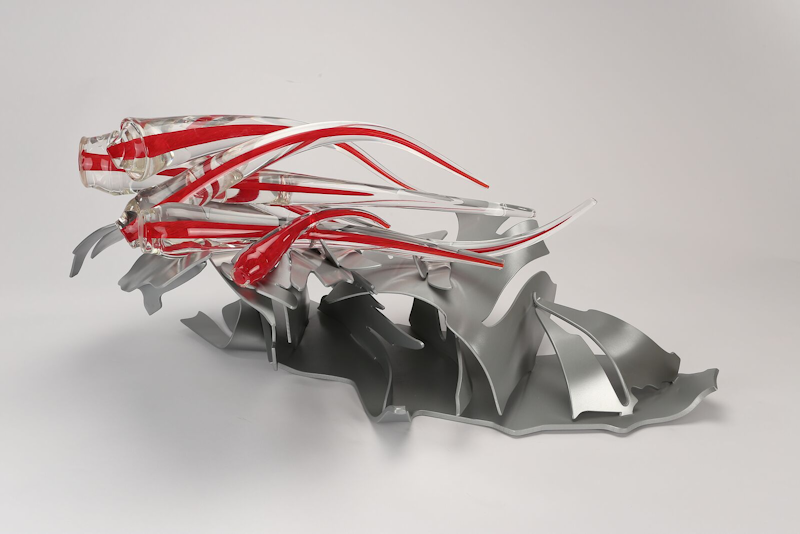
I was truly impressed by Complementary Contrasts: The Glass and Steel Sculptures of Albert Paley at Museum of Glass, and I thoroughly enjoyed it. Prior to visiting this show, I had seen only photographs of Paley’s work, which is much more powerful when seen in person. Photographs do not come close to capturing the scale, color nuances and textures of his steel and glass sculptures. When two of the largest galleries at MOG are filled with his massive sculptures, it can be overwhelming, so I advise viewers to give themselves plenty of time to study each piece up close and to take in the large group as a beautiful world of form and color.
Paley’s sculptures are large, but not gigantic, averaging around three-by-four-by-five feet in dimension but looking much more massive than their actual size. They create the feel, if not the actual appearance, of huge metal and glass machines such as locomotives barreling down the tracks, or of animals or humans wrestling with one another. There is a tremendous sense of movement —unrelenting, fast movement such as in the art of the Italian futurism movement of the early 20th century combined with the massiveness of John Chamberlain’s sculptures created from wrecked cars.
The term “complementary contrasts” in the show’s title perfectly describes the major emphasis of Paley’s sculpture. "Glass pairs beautifully with steel because it creates a dialogue of opposites. The contour, clarity and color of glass — metal responds to that. I want to literally fuse them together. I have always like that idea: yin and yang, a sense of unity," Paley wrote.
As an artist and a critic, I have always held that unity within variety or the balance or blending of opposites is a hallmark of great art, and these principles are at the heart of Paley’s art. Glass is clear, transparent, fragile; steel is hard, opaque, unbreakable. Opposites in every way. In Paley’s sculpture these opposites clash like warriors in battle, and yet they become indistinguishable in places. The glass is not always and everywhere transparent and fragile in appearance; in some of these works the glass is as opaque and solid in appearance as the steel, which in some places appears as pliable as slabs of leather. The first piece to greet the eye when entering the gallery is “Divide,” a piece that epitomizes the duality and contrasts of all the works. It is broken into two halves with abstract, tubular forms on each side that look like some kind of steampunk machine being carried on a flat-bed rail car which also looks like a skateboard made of a flat slab of steel resting on cylindrical rollers.
Also remindful of a flat-bed rail car is “Split Relationship,” twisted sheets of flat steel and rectangular glass blocks stacked in a V shape on the top. It can be seen as two forms or figures, similar but contrasting, as the forms in “Divide,” or as a single object or figure being split asunder by the V-shaped glass. The glass is clear but solid and heavy, while the steel is luminescent with sparkling red ochre and purple colors.
In addition to the many sculptures, the walls are filled with loose and energetic studies in pencil and graphite, showing that Paley is as competent with two dimensions as with three.
Also on display at MOG is a show of glass art by Michael E. Taylor which is conceptual and luminous and based in large part on science and math.
Complementary Contrasts: The Glass and Steel Sculptures of Albert Paley, Wednesday-Saturday, 10 a.m. to 5 p.m., Sunday, noon to 5 p.m., through September 3, 2018, $5-$15, free to members, free Third Thursday, Museum of Glass, 1801 Dock St. Tacoma, (866) 468-7386 http://museumofglass.org]


Thursday, December 28, 2017

Cutting a window into the trestle


Jeremy Mangan mural installed under trestle at Freighthouse Square
By Alec Clayton
Published in the Weekly Volcano, Dec. 28, 2017
Crane installing one of a dozen mural panels, photo courtesy Jeremy Mangan

A large mural measuring 7½ by 48 feet by Tacoma Foundation of Art Award winner Jeremy Mangan was installed beneath the railroad trestle near Freighthouse Square last week and revealed in an installation celebration at the Amtrak Cascades Station on December 15.
Titled "The Wood Carving Beach," the mural depicts a beach where wood carvings have piled up along with driftwood. Mangan says the carvings could have washed up on the beach, or they could have been carved on site, or both.
Mangan made a 12-inch by 77-inch painting in oil on panel. Then, Winsor Fireform in Tumwater scanned the painting, converted the colors to multichannel/duotone, enlarged it, and printed the image onto 12 steel panels, each 7½-feet tall by 4-feet wide, using porcelain enamel pigments. These panels were then fired in kilns and sealed to create the finished mural. The artist says the scanned and enlarged image accurately reproduces the painting down to the detail of a single brush hair embedded in the paint.
Mangan is a well-known Tacoma artist. In addition to the Foundation of Art Award, he has been the recipient of a 2015 Tacoma Artists Initiative program grant and a 2013 Artist Trust fellowship. He was a Neddy Award finalist, and he won the People's Choice Award at the Tacoma Art Museum’s 10th Northwest Biennial.
Mangan says, “I wanted the mural to relate to the neighborhood and the area. I wasn’t looking for overt connections, but rather more subtle overlaps in form and content. Wood and lumber became a central theme, and I took my primary cues from the clapboard construction of Freighthouse square, the wooden dome of the Tacoma Dome, the history of logging and lumber transport in the area, the timbers of the old railroad trestle itself, Thea-Foss waterway, the beaches and driftwood that surround us, and the history of wood carving and shaping in the Dome District and the region — indigenous peoples to present.
“Given the mural’s location on a retaining wall underneath the trestle, I wanted to create space, light, distance. I wanted to ‘cut a window.’ I thought about people driving and walking by, so I aimed to create an image that would work well from a distance and up close. And given the public nature of the piece, I wanted it to be inviting, bright and whimsical (but still with the dose of mystery and strangeness which is typical of my work). I wanted it to interest both adults and children. Hopefully it’s an enjoyable image that invites the viewer to both visually explore and posit narratives. Why are all these wood carvings on this beach? Where did they come from? How long have they been there? Why would someone go to the trouble to create them? I hope the mural stirs the imagination and rewards multiple viewings.”


The Wood Carving Beach by Jeremy Mangan, underneath the railway trestle at the intersection of E 26th and E G Streets in Tacoma's Dome District.

Shon Frostad’s maritime paintings at the Seaport Museum


Reviewed by Alec Clayton
Published in the Weekly Volcano, Dec. 28, 2017
 “47° North, 122° West, Turquois,” mixed-media painting by Shon Frostad, photo courtesy the artist
When I walked into the Seaport Museum to see Shon Frostad’s painting exhibition, there was a moment when I could not recognize the paintings as paintings, because the museum is filled with boats, anchors, charts, bones of whales, and other memorabilia of sea life, and I thought the paintings I saw on a wall to my left were sections of old ship hulls. As it turned out, they were paintings of sections of ship hulls —so realistic that they become almost surreal. Like Andy Warhol’s replicas of Brillo boxes, they are indistinguishable from what they are paintings of, yet clearly not the real thing. There’s something eerie about that, especially in such a setting as a seaport museum.
The title of the show comes from the symbols seen on the sides of commercial vessels.
The symbols on the ship's hull indicate such things as a vessel's 'draft', or depth in the water, what the allowable draft is for that vessel depending on the season, and even the particular ocean the ship may be traveling in,” says Frostad. “One circular symbol indicates the insurer of the vessel; another where a tugboat may or may not contact the ship's hull. Yet others show where a ship's inner bulkheads or compartments are.”
The tile of this show, 47 º North, 122 º Westrefers to the geographic coordinates for Tacoma.
Frostad’s paintings on wood panels vary in sizes up to 4-by-8 feet. Some of the lettering, as well as such painted details as brads and welded seams, are built up to a quarter inch above the surface, either through the use of thick paint or with some kind of gel or other media.
What stands out is the stark simplicity and straightforwardness of the images, the color combinations, and most of all the incredible textures that lend the works the look of rust, scratches, worn and peeling paint. The only thing separating them from actual sections of ship hulls is none of them are literally bent or scratched. It is all illusory trompe le’oeil painting.
In addition to these paintings, Frostad has included two more traditional modernist figure paintings, both of surfers. One, called “Hang Ten” is a close-up, realistic painting of feet with toes hanging off the front edge of a surfboard. The other one, “Surfers,” shows a line of surfers with tan bodies and swimsuits standing on a beach holding their upright surfboards. The figures are painted flat, with what appears to be pencil or graphite outlining their bodies. Both are nicely executed but do not have the visual impact of the paintings of ship hulls.
This is a show that is guaranteed to be enjoyable, and the museum itself is filled with fascinating memorabilia of a working seaport.

47° North, 122° West by Shon Frostad, 10 a.m. to 4 p.m., Wednesday through Saturday and noon to 4 p.m. Sunday, through Jan. 19, admission $6-$10, free to members and children under 5, 705 Dock Street, Tacoma, www.fosswaterwayseaport.org.