Saturday, November 9, 2013

The Weir at Tacoma Little Theatre


from left: Robert McConkey, Brian Jansen, David Wright, Ellen Peters and Gabriel McClelland


Published in The News Tribune, Nov. 8, 2013

I attended a rehearsal for The Weir at Tacoma Little Theatre. The set was not yet in place. They rehearsed on the set for Steel Magnolias, and one of the actors, David Wright, was still on book because he was a late replacement for another actor in the role of Jack – who has more lines than any other actor in the play. Despite these difficulties in seeing what the play may look like with full set and lighting, I was mightily impressed.

The five-person cast and Pug Bujeaud’s direction were exemplary. Wright was particularly impressive. His Irish brogue was great and he brought the crotchety old Jack to life with excellent timing and expression. He made it seem easy, probably because he is a veteran actor performed in the same play years ago and recently did a similar play by the same author at Harlequin Productions in Olympia.

The Weir was written by the great Irish playwright Coner McPherson. It won the Laurence Olivier Award for Best New Play of 1997-98 and was voted one of the 100 most significant plays of the 20th Century in a poll conducted by the Royal National Theatre, London. McPherson won the Critics' Circle Award as the most promising playwright that year.

This play is masterfully written, quiet, funny in places, spooky and emotionally draining. It is the story of four working class men who hang out in a small town Irish pub, drink excessively and talk a lot. An outsider joins their ranks: a woman named Valerie (Ellen Peters) who has recently arrived from Dublin. Her presence changes the dynamics of the four old friends who are accustomed to kidding around with each other. Although competition for her affection is never spoken of directly, the underlying sexual tension is undeniable.

The men take turns telling stories, which become increasingly spooky with talk of ghosts and fairies, and then Valerie tells her own story – a heartbreaking story that takes unexpected turns. Until this point in the play Peters plays Valerie as a polite and circumspect woman who remains mostly in the background, but as her story unfolds Peters’ depiction of emotion becomes overpowering.

Performing in this show are some of Puget Sound’s most talented actors. In addition to Peters as Valerie and Wright as Jack, the cast is rounded out with Gabriel McClelland as Finbar, a married businessman who spends most of the evening being protective of Valerie and mad at his friends; Brian Jansen, who plays Jim as a haunted man; and Robert McConkey, who is excellent in the role of the amiable barkeep, Brendan. All of them play their parts with such realism that you feel you are in the bar with them.
This show is recommended for ages 13 and older.  It contains strong language and some mature content. I found it to be captivating and haunting, and despite the strained emotions somehow comforting.

Tickets are $12.00 and may be purchased online at www.tacomalittletheatre.com, or by calling our Box Office at (253) 272-2281.

WHEN: 7:30 p.m. Friday and Saturday and 2:00 p.m. Sunday through Nov. 17
WHERE: Tacoma Little Theatre, 210 N “I” St., Tacoma
TICKETS: $12
INFORMATION: 253-272-2281, www.tacomalittletheatre.comt.

Also see Michael Dresdner's review
And see Michael's review of
See Michael Dresdner's review of Pride and Prejudice at Lakewood Playhouse.


American Roulette


American Roulette
Sofia achez-Muir and Molly Ellenbecker
I was mightily impressed with American Roulette, a joint production by Theater Artists Olympia and Animal Fire Theatre at Capital Playhouse, directed by Brian Hatcher.
The play by Christopher Evans and Fredric Hendricks is about a school shooting. It is presented monologue style with a sparse set and very few props. Actors enter one at a time, talk directly to the audience, and exit. Occasionally two or more will enter together and interact. This quiet, unpretentious presentation intensifies an already highly dramatic story. It is one day, 24 hours, in the lives of 11 characters, nearly all students, plus two radio personalities, a teacher and a construction worker who just happens to be working in the school when one of the students comes in and starts shooting.
We are given highly personalized glimpses into the lives of each of the people. We see what they like and dislike, what scares them, what and who they love and what they long for, and what drives them up the wall. Many of the monologues are insanely funny in the beginning; some are sad and touching.
And then all hell breaks loose. Not a surprise; there’s plenty enough foreshadowing, just as in actual mass shootings we see many signs in retrospect.
Ethan Bujeaud - photos by Michael Christopher
But mass shootings never end when the shooting stops. There is an aftermath, which is gut-wrenching, poignant and revealing.
The notable aspect of this play is that it does not lecture or moralize. There is no attempt to drive home a point, political or social. It is just lives laid bare.
Most of the actors are young and relatively inexperienced. They have to be because the characters are high school students. They all do a good job of becoming their characters. These are tough roles to play. Austin C. Lang brings depth to the football player, Brian, and is absolutely believable in the most dramatic scene in the play. Sofia Sanchez-Muir plays the cheerleader, Megan, with sensitivity. Robert Bristol is delightful as the punk druggy Bonzai. Ethan Bujeaud plays a troubled youth, Robert, in a convincingly understated, almost deadpan manner. We see turmoil beneath his almost expressionless demeanor. The adult actors are outstanding, especially Ryan Hendrickson as the history teacher, Christopher Rocco as Mike, the construction worker who holds a dying student in his arms, and Morgan Picton as the wild radio DJ, Dan.  
The director was a cast member of the original production, which took place on the campus of the University of Montana in April of 1999 and, coincidentally, closed 10 days before the shootings at Columbine High School, from which he graduated in 1988. The play has been slightly updated and has some regional references including, among others, a clever shout-out to local theater personality Michael Christopher.
American Roulette not well known. It is so obscure, in fact, that when I Google it all I can find is a video game by the same name, and when I Google the playwright’s name I find an actor and a British playwright, neither of whom is the author of this play. It should be better known. It should be performed in every town in America. Olympia, you’re lucky to have a chance to see this play.

WHERE: The Capital Playhouse, 612 E 4th Ave., Olympia
WHEN: Thursdays through Saturdays, 8 p.m. through Nov. 23 with a Sunday matinee at 2 p.m. Nov. 24
TICKETS: $12.00 at the door or at http://www.brownpapertickets.com
Theater Artists Olympia (TAO) http://www.olytheater.com
Animal Fire Theatre (AFT) http://www.animalfiretheatre.com

Friday, November 8, 2013

Open Studio Film viewing and discussion at Salon Refu


 My paintings will be the subject of a film viewing and discussion at Susan Christian’s studio space Salon Refu. There will be three short films with discussion after. Also some of the paintings featured in the films will be on view. All of the films were made by my wife, Gabi Clayton.

Portrait of Noel (4:48) is a stop-action film of me in the process of painting a portrait of our son, Noel, using stop-action animation to make the painting create itself to the rhythm of “Take Five” by the Dave Brubeck Quartet.

In Open Studio (9:37) a group of young adults, mostly TESC students, gathered in our apartment to discuss my paintings with me. The paintings were displayed on the walls. These were not art students; they were mostly film students, and rather than talking about the paintings from an artist’s point of view they talked about them in sociological terms or in terms of how they personally affected them. The paintings I was doing at the time — from approximately 1985 to 1990 — were all figurative. Many of the ones in this film were about sex. I don’t mean erotic or titillating art (although you never know what might turn folks on); I mean art that comments on, makes fun of or otherwise investigates our attitudes about sex and nudity. A lot of them were also intentionally humorous and/or bizarrely surrealistic.

Two Women (1:28) is another stop-action animation, this one of a single painting of two women sitting side-by-side.

During time period when these were made I was teaching in the Art Department the University of Southern Mississippi and Gabi, was a film student first at USM and later at The Evergreen State College. She filmed Open Studio as a class project at TESC. At that time I was transitioning from figurative to abstract painting.

Salon Refu is at 114 N. Capitol Way, downtown Olympia.
DATE: Dec. 6
TIME: 7 p.m.

Janice Arnold’s Palace Yurt


The Weekly Volcano, Nov. 7, 2013

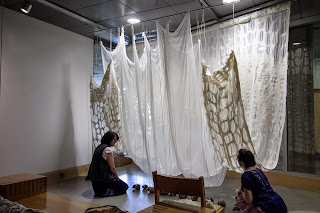
Janice Arnold’s Palace Yurt at the Smithsonian in 2009 was a contemporary take on ancient Mongolian palace yurts. Designed specifically for the Cooper-Hewitt National Design Museum’s 2009 Fashioning Felt exhibition in New York, it was made to fit the arched ceiling of the museum’s conservatory and filled the space like air in a balloon with elegantly crafted and draped sheets of handmade felt. Now Arnold has reconfigured the installation for the art gallery at The Evergreen State College. Working slowly with a team of assistants, it took Arnold most of the summer while the gallery was closed to complete the installation, which is one of the best gallery shows ever presented in that space.

Her Palace Yurt: Deconstructed is a massive, labor-intensive, excruciatingly detailed work of art that turns the gallery into a shrine and a mini-museum highlighting the history of traditional Mongolian felt making. The Mongolian yurts were places of worship built by people who sheared the sheep and make the felt by hand in a process that involved, among other interesting techniques, rolling it down the road by kicking it. Everything in the yurts has a history and a meaning.

Arnold, a fiber artist and TESC alumni who lives in Olympia and works out of a studio in Grand Mound, traveled to Mongolia to study the history, methods and spiritual meaning of felt and of palace yurts in order to reinterpret them for contemporary audiences. Faced with different limitations in space, particularly ceiling height, she could not duplicate the Smithsonian installation at Evergreen, but used all of the original parts reconfigured to fit in the different space, and she has included extensive photographs, drawings and schematics from the original — even including a specially made packing crate for the many arched metal rods the original yurt ceiling was tied to — along with videos and fabric samples viewers can touch to discover the tactile feel of the material. 
The walls, arches, and hanging ceiling are all made from massive sheets of hand-make felt. Placed in the front window is a beautiful screen made of reeds wrapped in wool.

Arnold and her assistants pull, soak, dry and roll the sheets of felt in a modern version of the methods made by the Mongolian villagers. Much of the work is done on the floor and outside on the ground. When working in the winter, crystals formed on the wet felt and she later duplicated that by attaching crystals to the felt walls in the gallery.

The completed yurt in the gallery and the separate wall pieces, drawings, videos, etc. combine to make a beautiful, startling and spiritually moving environment.

Visiting this installation should be worth the drive from anywhere in Western Washington. You may never get another chance to see anything like this. When you go, give yourself plenty of time to carefully study all of the support materials, including the videos. In many ways the entire installation is like a jigsaw puzzle. You put the pieces together in your by reading the information and coming to understand the process.
Janice Arnold will be at Evergreen to present a lecture Nov. 20 from 11:30 a.m. to 1 p.m. in Lecture Hall 1.

[The Evergreen State College Gallery, Palace Yurt: Deconstructed, Monday-Friday 10 a.m. to 5 p.m., closed for lunch 1-1:30 p.m. Mon, Tue., Thurs., through Dec. 11, 2700 Evergreen Parkway NW, Library 1st floor, Olympia]

Photos: Palace Yurt installation view (details). Photo by Bob Iyall